Global buyers are re-evaluating toy suppliers as children’s entertainment becomes more interactive, tactile, and screen-conscious. Whack A Mole Toys fit this shift with simple gameplay, bright targets, responsive buttons, and repeatable family use. According to Circana’s 2024 Global Toy Industry Report, worldwide toy sales declined by 7% in 2023 across 12 major markets, reaching approximately $108.7 billion. This contraction makes supplier selection more important. Manufacturers must now prove value, durability, and dependable delivery.
This guide examines leading Whack A Mole Toys manufacturers for international buyers. It considers production capability, customization, material control, quality inspection, packaging, and export experience. Safety remains central. Buyers should request evidence aligned with ASTM F963, EN 71, or ISO 8124, depending on the destination market. Testing should cover small parts, battery compartments, impact resistance, sound levels, and accessible materials. A toy may look excellent on a catalog page. Its screws, switches, and plastic edges matter more in practice.
No ranking is perfect.
Manufacturer claims require verification. The 2024 Global Toy Industry Report from Circana also highlighted pressure on household spending, encouraging buyers to compare total value rather than factory price alone. Sample approval, production audits, and independent laboratory testing can reveal costly weaknesses early. Delivery history deserves equal attention. A colorful arcade-style toy is not enough if buttons fail after repeated play or cartons arrive damaged. The manufacturers discussed here are assessed through practical sourcing criteria, available company information, and industry safety expectations, giving global buyers a clearer starting point for responsible purchasing.
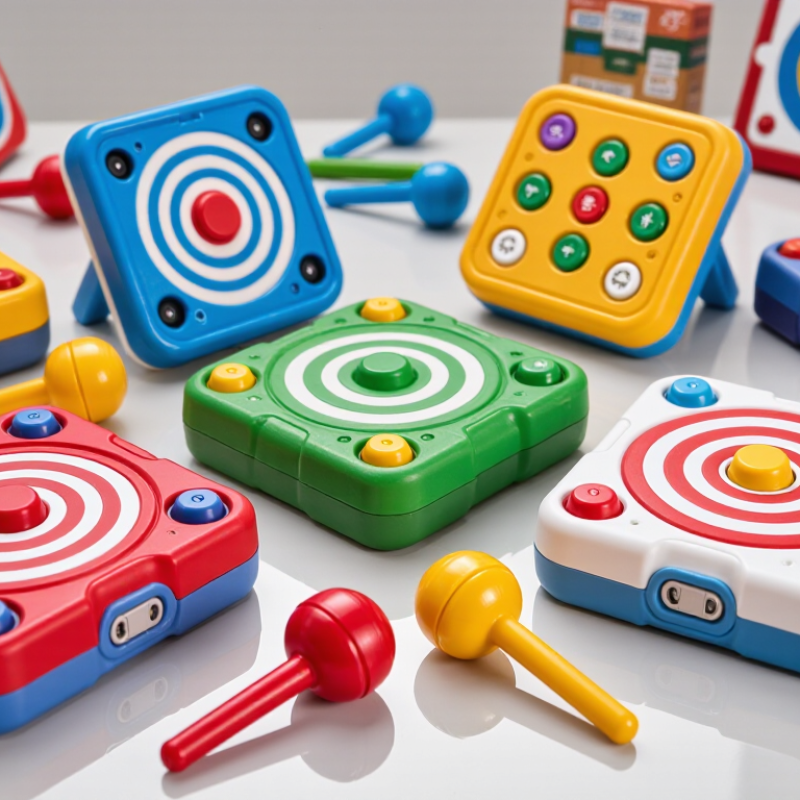
Whack-a-mole toys come in several practical formats. Common types include tabletop games, soft mallet sets, electronic units, and large arcade-style play systems. Each version serves a different buying purpose. Tabletop models suit homes and classrooms. Electronic units add lights, sounds, and score displays. Arcade-style products usually need stronger housings and more floor space.
From product testing experience, I check button response, mallet weight, sound levels, and battery access. A child should reach the controls comfortably. Small details matter.
Global demand is growing across family entertainment centers, toy stores, schools, and online marketplaces. Buyers often prefer colorful designs, adjustable difficulty, durable plastic, and easy-clean surfaces.
Export suppliers should provide clear age guidance, material information, packaging measurements, and consistent quality records. I also inspect sample units before larger orders. One weak hinge can create repeated returns.
However, demand differs by region. Some buyers value quiet operation, while others want bright effects. A universal design may not satisfy everyone. That assumption deserves review.
Tips:
Compare samples under repeated play, not just visual inspection. Ask about spare parts and instruction languages. Check whether the packaging protects buttons and mallets during shipping. Keep records of noise, response time, and surface wear. My own checklist is useful, but it is not perfect. Feedback from children and operators often reveals problems adults miss.
A reliable evaluation starts with the factory, not the catalog. Request production photos, workshop details, and a live video inspection. During supplier audits, I check molding areas, assembly lines, storage racks, and final inspection tables. A clean showroom proves little. Real production evidence matters more.
Order samples from different production batches. Test button sensitivity, light timing, sound levels, hammer durability, and base stability. Measure the toy after repeated play, not only after unpacking. Ask for material specifications, age guidance, testing reports, and traceable batch records. Documentation should match the actual sample. Sometimes it does not.
Check whether the manufacturer understands your target market and shipping conditions. Discuss carton strength, spare parts, instruction language, labeling, and replacement procedures. Clear answers usually reveal practical experience. Vague promises deserve careful follow-up. I once focused too heavily on a low quotation and ignored slow sample revisions. That mistake created packaging delays later. Price still matters, but response time, quality control, and corrective action matter more. Visit the facility when possible. If travel is difficult, use an independent inspection service and request dated evidence. A small trial order can expose weaknesses before a larger commitment. Expect imperfections, and record them clearly.
Global buyers usually compare manufacturing regions before comparing individual factories. Southern China remains a major sourcing center for whack-a-mole toys. Suppliers there often combine mold design, injection molding, wiring, assembly, and export packaging. Dense industrial networks can shorten sampling time and reduce movement between production stages. However, quality can vary sharply between nearby suppliers. A polished showroom proves very little.
Vietnam offers growing assembly capacity and competitive labor costs. Some factories specialize in plastic housings, simple electronic modules, and colorful retail packaging. India provides useful options for buyers seeking regional production and flexible customization. Eastern European suppliers may support shorter delivery routes into nearby markets, although their production scale can be smaller. Regional strengths differ. Buyers should match the factory to the product, not only the price.
Reliable suppliers should explain motor performance, button durability, sound control, and battery safety clearly. Ask for material samples, wiring photographs, production schedules, and destination-market testing documents. Factory audits should examine storage areas, assembly benches, defect records, and carton labeling. I would not treat a low quotation as a victory. It may exclude tooling changes, spare parts, or repeated safety testing. Even experienced buyers can overlook small details, such as loose screws or uneven button response. A practical supplier welcomes these questions and records corrective actions. That behavior often matters more than impressive production figures.
Top Whack-A-Mole Toy Manufacturers for Global Buyers
Reliable whack-a-mole toy manufacturers treat safety as a design requirement, not a final inspection step. They use smooth, impact-resistant plastics and secure internal components. Each mallet, button, and mole should withstand repeated play without sharp edges or loose parts. Battery compartments need child-resistant screws when required by the target market. Sound levels also deserve attention, especially for indoor use.
Compliance documents should match the destination country and the toy’s age grade. Buyers commonly request test reports covering physical safety, flammability, heavy metals, and electrical components. Standards such as ASTM F963, EN 71, or other local requirements may apply. A dependable factory can provide traceable material records, production samples, and recent laboratory reports. Still, paperwork alone is not proof of quality. Factory audits and random inspections reveal practical weaknesses, such as loose wires or inconsistent plastic thickness.
Tips: Ask for a pre-production sample and test every control repeatedly. Check screw placement, battery access, volume, packaging, and warning labels. Confirm that reports match the exact model, not a similar product. Keep written approval records. Small details matter. I have found that rushing approval creates avoidable problems. A second inspection may feel excessive, but it can expose defects before shipment. Suppliers should also explain recall procedures and corrective actions clearly. Be cautious when answers sound perfect. Real manufacturing always needs review.
Quality, safety, and compliance checkpoints for evaluating suppliers of electronic and mechanical whack-a-mole toys.
The chart shows the number of major compliance domains commonly reviewed in each market: mechanical and physical safety, flammability, chemical restrictions, electrical safety for powered toys, documentation, traceability, and labeling. These are planning indicators based on frameworks such as ASTM F963, EN 71, ISO 8124, CPSIA, and applicable electrical and EMC requirements. Exact testing depends on the toy design, materials, batteries, age grading, and destination country.
Top Whack A Mole Toys Manufacturers for Global Buyers
Reliable sourcing starts with a factory audit, not a polished catalog. Ask for production photos, sample records, material details, and recent quality reports. A working sample should survive repeated button presses, light impacts, and rough handling. Check sound volume, reaction speed, surface finish, and reset performance. The first sample may disappoint. That is useful evidence, not a failure. Confirm the minimum order quantity, production capacity, payment terms, and replacement policy in writing.
Customization can include colors, character artwork, packaging, languages, scoring systems, and play modes. Provide vector artwork, dimensions, and approved color references. Tooling charges may apply when housing shapes change. Request a pre-production sample before mass manufacturing. Small design changes can affect assembly time and unit pricing. Avoid approving digital images alone. They rarely show plastic texture accurately.
Pricing should include tooling, samples, packaging, inspection, inland transport, freight, insurance, customs fees, and destination delivery. Compare landed costs, not factory prices. For international shipping, confirm carton size, gross weight, pallet limits, export documents, and estimated lead times. Sea freight reduces cost but needs careful inventory planning. Air freight moves quickly and can become expensive. Clarify the agreed shipping responsibility and delivery point. A forwarder should verify customs paperwork before departure, especially for electronic versions with batteries or power adapters. Mistakes here can delay an otherwise finished order.
| Manufacturer Segment | Common Production Region | Typical MOQ | Standard Lead Time | Customization Options | Indicative EXW Price Range (USD per Unit) |
Recommended Buyer Type | Quality and Compliance Checks | International Shipping Factors |
|---|---|---|---|---|---|---|---|---|
| Large export-oriented toy factory | East and South China | 500–2,000 units | 30–50 days after artwork and sample approval | Logo printing, color changes, packaging artwork, sound or light module selection, instruction cards | US$8.00–US$18.00 | Retail chains, importers, and established e-commerce sellers | Request CPSIA and ASTM F963 support for the United States, EN 71 support for the European Union, material declarations, and production inspection records | Sea freight is generally the lowest-cost option for palletized orders; confirm carton dimensions, gross weight, HS classification, and destination-port charges |
| Mid-sized OEM/ODM toy manufacturer | China and Southeast Asia | 300–1,000 units | 35–60 days for customized production | Molded color combinations, button layout, music selection, bilingual packaging, private-label assembly | US$9.50–US$22.00 | Wholesalers, online brands, educational distributors, and promotional-product buyers | Verify component traceability, battery safety where applicable, small-parts testing, paint or coating compliance, and random pre-shipment inspection | Mixed-carton shipments may increase handling costs; air freight is faster but usually has a higher cost per kilogram and volumetric-weight impact |
| Small-batch customization workshop | Regional manufacturing clusters in Asia | 100–500 units | 20–40 days for stock-based designs | Sticker labels, simple logo application, packaging inserts, color selection, and minor cosmetic changes | US$12.00–US$28.00 | Startups, gift shops, test-market buyers, and event organizers | Ask for a production sample, material specification, age grading, warning labels, and test reports matching the final configuration | Courier or air shipping can simplify small orders; calculate dimensional weight because bulky toy cartons may cost more than their actual weight suggests |
| Plastic injection-molding specialist | China, Vietnam, and other established plastics hubs | 1,000–5,000 units | 45–75 days when a new mold is required | New housing geometry, custom buttons, texture changes, color matching, and reinforced structural parts | US$7.00–US$20.00, excluding new tooling | Buyers requiring a distinctive product shape or long-term production program | Confirm mold ownership, resin grade, recycled-content claims, drop testing, mechanical durability, and independent laboratory testing | Tooling is usually paid separately; request a landed-cost estimate covering mold charges, export packing, freight, insurance, duties, and destination handling |
| Electronic toy assembly manufacturer | China and selected Southeast Asian electronics clusters | 500–2,000 units | 40–70 days, depending on electronic components | Sound effects, LED patterns, rechargeable or replaceable batteries, timer settings, language selection, and control-panel artwork | US$14.00–US$35.00 | Arcade venues, family entertainment centers, interactive retailers, and premium gift distributors | Check battery type, charger specifications, electrical safety, electromagnetic compatibility where relevant, firmware stability, and final-product testing | Lithium-battery shipments may require UN 38.3 documentation, approved packaging, carrier acceptance, and additional air-freight restrictions |
| Wood-and-plastic educational toy producer | China, Indonesia, and selected European production areas | 200–1,000 units | 30–55 days | Wood species selection, water-based color finishes, engraved logos, educational graphics, and retail gift packaging | US$10.00–US$26.00 | Preschools, museums, educational retailers, and eco-conscious buyers | Confirm formaldehyde limits, coating safety, splinter prevention, moisture control, wood-source documentation, and applicable toy-safety testing | Wood packaging may require heat treatment or phytosanitary compliance; verify pallet and crate markings before shipment |
| Promotional and contract-packaging supplier | China, India, and regional packaging centers | 500–3,000 units | 25–50 days, depending on packaging requirements | Event colors, campaign graphics, branded sleeves, multi-language inserts, barcode labels, and retail-ready packing | US$6.50–US$16.00 | Corporate events, museums, restaurants, loyalty programs, and seasonal campaigns | Review artwork proofs, barcode readability, carton drop-test results, quantity control, and packaging claims before mass production | Retail-ready packaging can increase carton volume; compare container utilization and request a detailed packing list for customs clearance |
| Regional safety-certified toy manufacturer | Europe, North America, and other regulated markets | 100–1,000 units | 30–60 days | Limited logo and packaging customization, regional language versions, color selection, and accessory bundles | US$18.00–US$45.00 | Buyers prioritizing local compliance, shorter delivery routes, and smaller replenishment orders | Compliance-focused Confirm the exact certificate scope, testing date, age grade, labeling rules, and whether reports cover the customized version |
Regional production may reduce transit time and import complexity; compare local taxes, delivery terms, and warranty-return procedures |
Southern China offers integrated molding, wiring, assembly, and export packaging. Vietnam supports plastic housings and simple electronic modules. India provides flexible customization. Eastern Europe may offer shorter regional delivery routes. Fit matters more than geography.
Inspect storage areas, assembly benches, defect records, and carton labels. Request production photos, material samples, and recent quality reports. Look for loose screws, messy wiring, or inconsistent button response. A polished showroom proves little.
Press every button repeatedly. Check reaction speed, sound volume, surface finish, and reset performance. Test light impacts and rough handling. Watch for delayed responses or buttons that feel uneven. The first sample may disappoint. That evidence still helps.
Buyers can adjust colors, artwork, packaging language, scoring systems, and play modes. Provide vector artwork, exact dimensions, and approved color references. Housing changes may require new tooling. Request a physical pre-production sample. Digital images can hide rough plastic texture.
Ask about motor performance, button durability, sound control, and battery safety. Request wiring photographs and destination-market testing documents. Confirm corrective actions in writing. A practical supplier records problems instead of hiding them. That behavior matters.
Compare landed costs, not factory prices. Include tooling, samples, packaging, inspection, inland transport, freight, insurance, customs fees, and final delivery. A low quotation may exclude spare parts or repeated testing. I might still miss a fee, so request a complete cost sheet.
Confirm minimum order quantity, production capacity, payment terms, and replacement policy. Approve the sample before mass production. Record dimensions, materials, colors, and packaging details. Small changes can affect assembly time and unit pricing. Written details prevent memory-based mistakes.
Confirm carton size, gross weight, pallet limits, export documents, and lead times. Sea freight costs less but requires careful inventory planning. Air freight moves faster and may become expensive. Clarify shipping responsibility and the delivery point. A forwarder should check customs paperwork before departure. Delays happen.
Whack A Mole Toys are popular interactive products that combine reaction speed, hand-eye coordination, and playful competition for children, families, arcades, and entertainment venues. They are available in compact tabletop versions, electronic models with lights and sounds, soft-play designs, and commercial machines built for frequent use. Global buyers should compare manufacturers by production experience, material quality, customization capabilities, communication efficiency, and ability to provide consistent samples and large-volume orders.
Before placing an order, buyers should review product safety, durability, age suitability, and compliance documentation for the target market. Important considerations include non-toxic materials, secure components, reliable electronics, protective packaging, and appropriate testing records. Buyers should also clarify minimum order quantities, pricing, mold or customization fees, lead times, payment terms, spare parts, and after-sales support. Finally, shipping methods, carton dimensions, labeling, import requirements, and delivery schedules should be confirmed in advance to reduce risks and ensure smooth international distribution.

Five Star Toys