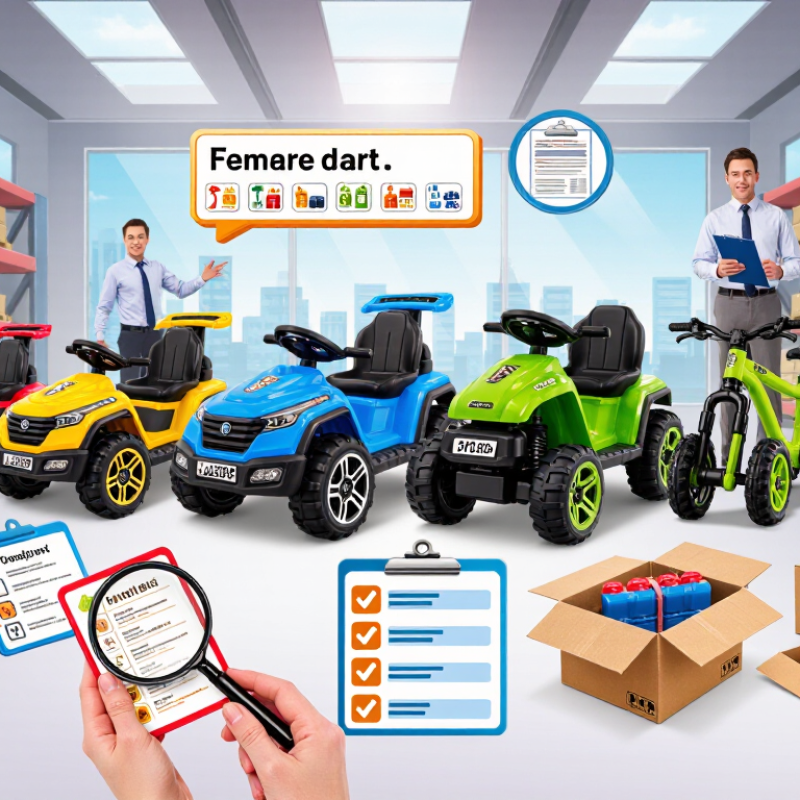
10 Tips for Buying Ride On Toys Wholesale?

Time:2026-10-05 Author:Ethan
0%

Buying Ride On Toys wholesale can look simple until costs, safety checks, and delivery delays affect your margin. A bright electric car may attract buyers, yet its battery quality, wheel strength, and replacement parts matter more over time. This guide introduces ten practical tips for choosing products, suppliers, prices, and customer support with greater confidence.

Richard Gottlieb, CEO of Global Toy Experts and a respected toy-industry analyst, has stated, “A great toy is not enough; it must also reach the right consumer at the right price.” That principle fits Ride On Toys especially well. Wholesale buyers must compare more than the product photograph. They should request samples, inspect charging systems, review age guidance, and confirm clear safety documentation. Supplier experience matters. So does communication.

Look closely.

The following tips cover supplier verification, minimum order quantities, shipping terms, packaging protection, battery performance, warranty policies, and seasonal demand. They also examine how to calculate landed cost instead of trusting the factory price alone. A low quote can hide expensive freight, damaged cartons, or slow spare-parts support. I have seen buyers focus on unit price and overlook storage space. That mistake can quietly reduce profits.

No purchasing method is perfect. Market demand changes, and customer expectations vary by region. Therefore, responsible buyers should test limited quantities before committing to large orders. They should also keep written records of inspections and supplier promises. These steps require patience, but they create a more dependable wholesale process and a stronger foundation for long-term Ride On Toys sales.

10 Tips for Buying Ride On Toys Wholesale?

Define Your Wholesale Ride-On Toy Requirements

Define Your Wholesale Ride-On Toy Requirements

Before requesting wholesale prices, write down who will use the ride-on toys and where they will operate. A toddler model may suit indoor play areas, while an older child needs stronger wheels and a wider seat. Record the target age range, rider weight, vehicle dimensions, speed setting, and expected daily use. Be specific. “For children” is not enough.

Think about the purchasing environment. Measure doorways, storage shelves, display spaces, and carton limits. Outdoor buyers should examine tire grip, water resistance, ground clearance, and battery charging time. Indoor retailers may value quieter motors and smaller turning circles. Ask suppliers for material details, safety testing records, user instructions, and replacement-part availability. Reliable documentation matters more than attractive product photos.

Your budget should include freight, packaging, assembly, spare batteries, and possible damaged units. Confirm the minimum order quantity and lead time in writing. I once focused too heavily on the unit price and underestimated warehouse space. That mistake reduced the real profit. Leave room for inspection costs and seasonal demand. Requirements can change after customer feedback, so keep a simple review sheet for returns, battery performance, and common assembly problems. Small details often decide whether a wholesale order works.

10 Tips for Buying Ride On Toys Wholesale? - Define Your Wholesale Ride-On Toy Requirements

Tip Requirement Dimension Recommended Wholesale Specification Key Data to Confirm Before Ordering Planning Note
1 Target Age and User Size Confirm the recommended age range, maximum user height, seat width, footwell size, and whether adult supervision is required. Age suitability affects product selection, packaging, safety instructions, and sales-channel approval.
2 Maximum Load Capacity Request the tested maximum load, recommended operating conditions, and whether the capacity applies to one child or multiple users. Choose capacity with a practical margin rather than matching the child's current weight exactly.
3 Power System and Battery Confirm battery chemistry, capacity in Ah, charging time, charger input voltage, expected play time, battery replacement method, and spare-part availability. Battery specifications influence freight handling, storage requirements, running time, and customer satisfaction.
4 Speed and Driving Control Check forward and reverse controls, speed settings, soft-start performance, parental remote control, braking behavior, and emergency stop functions where applicable. Lower and controllable speeds are generally more suitable for beginners and indoor or residential use.
5 Safety Features Ask for applicable test reports, warning labels, user manuals, material declarations, and documented inspection procedures for each production batch. Safety documentation should match the destination market and the exact product configuration being purchased.
6 Product Dimensions and Storage Confirm assembled dimensions, folded or detachable-part dimensions, carton dimensions, product weight, gross shipping weight, and pallet quantity. Dimensions determine warehouse space, retail display suitability, shipping cost, and last-mile delivery handling.
7 Materials and Build Quality Verify plastic type where required, paint or coating durability, wheel material, motor protection, connector quality, and sample performance after repeated use. A pre-production sample and a small trial order can reveal defects that may not appear in product photographs.
8 Order Quantity and Customization Confirm minimum order quantity, mixed-model or mixed-color rules, customization charges, sample fees, tooling costs, production lead time, and reorder terms. Standard configurations usually reduce complexity, while customization may require higher volume and longer lead times.
9 Packaging and Transportation Confirm carton drop-test procedures, packaging dimensions, container loading quantity, battery shipping classification, and damage-claim procedures. Packaging quality directly affects landed cost, breakage rates, returns, and warehouse receiving efficiency.
10 Quality Control and After-Sales Support Confirm warranty duration, replacement-part list, motor and battery service policy, defect tolerance, inspection records, and response time for technical support. Reliable spare parts and clear warranty terms help reduce downtime and protect the long-term wholesale relationship.

Evaluate Supplier Quality, Safety, and Compliance

10 Tips for Buying Ride On Toys Wholesale?

Supplier quality should be judged through evidence, not polished factory photos. Request current, third-party test reports for the exact model, battery, charger, and materials. In the United States, ASTM F963 and CPSIA requirements are key references. For European sales, suppliers should support relevant EN 71 testing and conformity documentation. A certificate for a similar product is not enough.

The U.S. Consumer Product Safety Commission reported about 231,000 toy-related emergency department injuries involving children under 14 in 2023. Ride-on products need extra attention because speed, weight, and battery power increase potential hazards. Check braking distance, wheel stability, seat restraint points, charging protection, wiring insulation, and accessible pinch areas. Ask whether each production batch receives functional testing. Small details matter.

Ask for factory audit records, material declarations, sample approval procedures, and a clear recall-response process. Verify age labels and warnings on the physical packaging, not only in digital files. Keep serial numbers, inspection photos, and shipment samples for traceability. This feels slow, but it protects future orders.

Do not trust perfect paperwork alone. I would test several units, including one from the middle of production. Supplier promises can change. Battery performance may also vary between batches. Review CPSC recall notices and EU Safety Gate alerts before placing large orders. A low wholesale price becomes expensive when defects, returns, or unsafe charging appear later.

Compare Pricing, Minimum Orders, and Shipping Terms

When buying ride-on toys wholesale, compare the complete landed cost, not only the factory price. A low unit price can hide expensive batteries, spare parts, packaging, or quality inspections. Request a written quotation showing toy price, customization fees, carton dimensions, and payment terms. Compare at least three suppliers using the same specifications. Otherwise, the numbers can mislead you.

Minimum order quantity matters as much as pricing. A supplier may offer a discount at 500 units, but your storage space may support only 150. Ask whether mixed colors or models count toward the minimum order. Confirm sample costs and whether they become refundable after a larger purchase. I once underestimated storage charges, and that mistake reduced the expected margin. Small details matter.

Shipping terms require careful reading. Check whether the quote includes export handling, insurance, port charges, and final delivery. Ask for the estimated production time and a realistic shipping window, especially before seasonal demand. Compare air and sea freight by total cost, volume, and urgency. Request carton weight, pallet requirements, and tracking procedures. A delayed shipment can be more damaging than a higher unit price. Keep every agreement in writing, including inspection standards, replacement procedures, and payment milestones. The cheapest offer is not always the safest purchase.

Inspect Product Features, Materials, and Age Suitability

When buying ride-on toys wholesale, inspect the product before discussing price. A glossy sample can still hide weak steering joints or loose battery wires. Check wheel alignment, brake response, seat stability, and charging protection. Small gaps around moving parts deserve attention. They can trap tiny fingers. The U.S. Consumer Product Safety Commission reported more than 230,000 toy-related emergency-room injuries among children under 15 in 2023. That figure makes physical testing a purchasing requirement, not a marketing detail.

Material checks should be specific. Ask for test reports covering plastics, coatings, batteries, and electrical components. CPSC requirements limit lead in children’s products to 100 parts per million and lead in surface coatings to 90 parts per million. Phthalates are restricted to 0.1% in certain accessible plasticized parts. Verify batch numbers, laboratory dates, and sample matching. A certificate without traceable product details is weak evidence. It happens more often than buyers admit.

Age suitability needs practical judgment. Compare the recommended age with speed, weight capacity, seat depth, control method, and supervision needs. A fast model may suit an older child but overwhelm a smaller rider. Read the relevant sections of ASTM F963 and request documentation from an accredited laboratory. Age labels alone are not enough. I would also test assembly instructions with someone unfamiliar with the product. If they struggle, parents probably will too. Wholesale buyers sometimes overlook this simple check.

10 Tips for Buying Ride-On Toys Wholesale

Use this practical inspection-priority model to compare ride-on toys before placing a wholesale order. The scores reflect the relative importance of safety, age suitability, durability, and after-sales readiness.

How to use the chart: Prioritize products that perform well in age and weight suitability, speed control, braking, battery safety, structural stability, and compliance documentation. Always verify test reports, manuals, packaging requirements, and applicable regulations for your target market.

Finalize Your Order Through Sampling and Contract Review

10 Tips for Buying Ride On Toys Wholesale?
Finalize Your Order Through Sampling and Contract Review

A wholesale order should begin with a working sample, not a polished catalog photo. Ask for one production-style unit with the intended motor, battery, charger, tires, seat, and remote control. Test it on tile, carpet, and a gentle slope. Check braking, steering response, charging time, noise, and surface temperature after use. Details matter.

Record every finding with photos and measurements. Inspect welds, plastic edges, wheel alignment, cable protection, and packaging strength. Confirm the sample’s stated load capacity through practical testing, while avoiding promises beyond verified results. Request material information, user instructions, warning labels, and applicable safety test reports. Test it cold. Then test it again after repeated use.

Your contract should identify the exact sample version, product specifications, colors, accessories, carton dimensions, and approved artwork. Include production tolerances, inspection rights, delivery dates, payment stages, spare-part support, defect handling, and warranty responsibilities. Specify what happens when goods differ from the approved sample. A pre-shipment inspection can reduce surprises, but it cannot replace clear contract language. I once focused too heavily on appearance and missed a charger detail, creating avoidable rework. That mistake changed my review process. Do not rush. Read the battery terms, charging requirements, replacement procedures, and documentation line by line before approving the order.

FAQS

What information should I define before requesting wholesale prices?

Record the target age, rider weight, vehicle size, speed setting, and expected daily use. “For children” is too vague. Also describe the operating space.

How should I choose between indoor and outdoor ride-on toys?

Indoor models may need quieter motors and tighter turning circles. Outdoor models should have suitable tire grip, water resistance, and ground clearance. Measure doorways, shelves, display areas, and storage space before ordering.

What should I request from a supplier?

Ask for material details, user instructions, warning labels, safety test reports, and replacement-part information. Product photos are not enough. Documentation matters more.

Which costs belong in the wholesale budget?

Include freight, packaging, assembly, spare batteries, inspection, and potentially damaged units. Check the minimum order quantity and lead time in writing. Unit price can mislead.

Why should I order a working sample first?

A production-style sample reveals practical problems hidden by catalog images. It should include the intended motor, battery, charger, tires, seat, and remote control. Test the real version.

How should I test a ride-on toy sample?

Test it on tile, carpet, and a gentle slope. Check braking, steering response, charging time, noise, and surface temperature. Test it cold. Test it again after repeated use.

What physical details should I inspect on the sample?

Photograph welds, plastic edges, wheel alignment, cable protection, and carton strength. Measure important parts and compare them with the specifications. Small defects become expensive later.

What should the wholesale contract include?

Identify the approved sample, specifications, colors, accessories, carton dimensions, and artwork. Include tolerances, inspection rights, delivery dates, payment stages, spare-part support, defect handling, and warranty duties. Write the disagreement process clearly.

How can I avoid mistakes during final approval?

Review battery terms, charging requirements, replacement procedures, and documents line by line. A pre-shipment inspection helps, but it cannot replace clear contract language. I once checked appearance carefully and missed a charger detail. That created avoidable rework.

Conclusion

Buying Ride On Toys wholesale requires careful planning to ensure the products match your market, budget, and customer expectations. Start by defining the desired toy types, quantities, age ranges, designs, and target price points. When evaluating suppliers, review their manufacturing capabilities, product consistency, safety testing, and compliance documentation. Clear communication about quality standards and production timelines can help reduce risks before placing an order.

Next, compare total pricing rather than focusing only on unit cost. Consider minimum order quantities, customization fees, packaging, shipping methods, delivery times, and payment terms. Inspect materials, construction, battery or power systems, controls, protective features, and age suitability to confirm that each product is practical and durable. Before finalizing the purchase, request samples, test them carefully, clarify inspection procedures, and review the contract for specifications, warranties, replacement policies, and delivery responsibilities. This organized approach supports more reliable sourcing and long-term wholesale success.

Ethan

Ethan

Ethan is a seasoned marketing professional with a deep expertise in our company's innovative product line. With a passion for sharing knowledge and insights, he takes the lead in regularly updating our corporate blog, where he explores industry trends, product features, and effective marketing......