Toy Tablets are becoming practical additions to children’s product catalogs, especially for wholesale buyers seeking affordable screen-based play. Their appeal often begins with bright icons, soft edges, and simple touch controls. Yet successful purchasing requires more than attractive packaging. Buyers should examine age suitability, screen response, battery performance, storage capacity, sound levels, and physical durability before placing large orders.
In real sourcing work, samples reveal details that product photos hide. A tablet may feel sturdy but develop loose buttons after repeated handling. Another model may offer colorful games but lack meaningful learning content. Ask suppliers for clear specifications, safety documentation, warranty terms, packaging details, and replacement support. Small issues matter. A weak charging port can create returns. Unclear instructions can frustrate parents and retailers. Wholesale buyers should also compare minimum order quantities, lead times, customization options, and sample feedback from actual children and caregivers. Price remains important, but the cheapest unit may not deliver the lowest total cost. That lesson is easy to overlook.
Reliable suppliers explain limitations instead of promising perfect performance. They should communicate honestly about battery life, software updates, language options, and expected product lifespan. Buyers can improve decisions by recording test results and checking every shipment against approved samples. Still, no evaluation predicts every customer experience. Children use products roughly, and preferences differ widely. This guide explores practical criteria for selecting Toy Tablets that balance play value, usability, quality control, and long-term wholesale potential. Mistakes may happen, but thoughtful testing reduces expensive surprises.
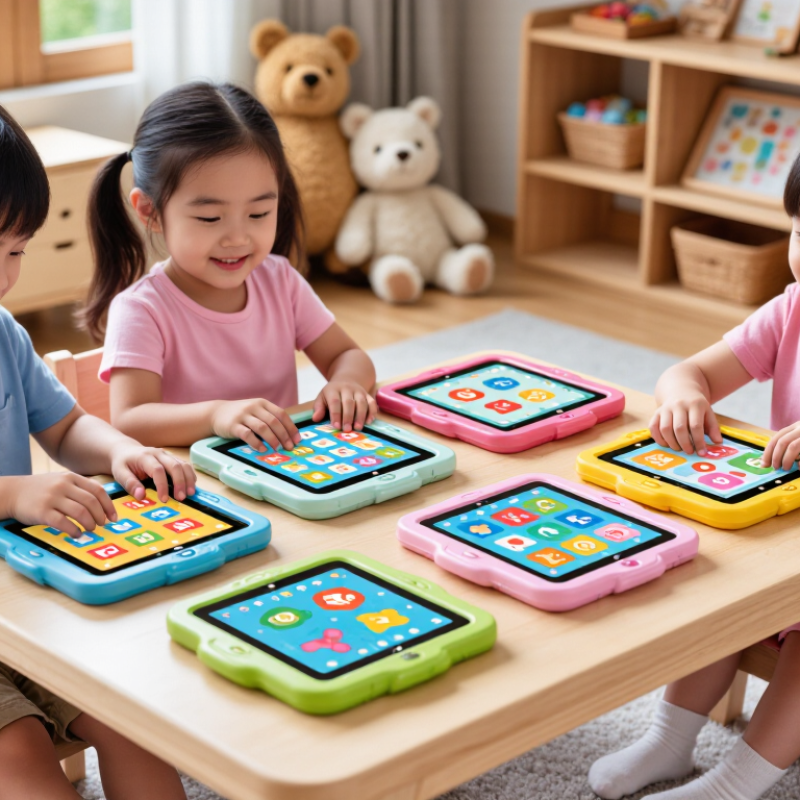
Toy tablets for wholesale buyers now span several distinct categories. Basic learning tablets use physical buttons, lights, sounds, and alphabet or number activities. They suit younger children and usually offer simple training for first-time users. Touchscreen learning tablets add drawing, reading, puzzles, and offline games. Their core features should include adjustable volume, durable screens, child-sized controls, and clear menus.
Pretend-play tablets imitate adult devices through role-play prompts, messages, calendars, or creative tasks. STEM-focused models introduce coding logic, sequencing, and problem-solving. According to Grand View Research’s Educational Toys Market Report, the global market was valued at over 57 billion dollars in 2022 and is expected to grow steadily through 2030. This supports demand for learning-led products, but educational labels alone prove little. Buyers should test whether activities build skills or simply repeat sounds.
Safety and usability affect repeat orders. The UNICEF Policy Guidance on AI for Children stresses privacy, transparency, and age-appropriate design, even when connected features are limited. Wholesale teams should check data settings, charging safety, language options, and replaceable accessories. Circana’s 2023 U.S. toy industry review reported total sales near 28 billion dollars, showing a large but competitive market. Bright screens attract attention. They do not guarantee learning. I would also request sample testing from real children, because adult product reviews often miss confusing icons, weak speakers, or tiring controls.
Age-based selection works best when it follows child development, not only screen size. For ages two to four, choose simple interfaces, large controls, offline stories, and short activity cycles.
The World Health Organization recommends no sedentary screen time for infants and no more than one hour daily for children aged two to four.
A tablet should support shared play, not replace conversation, movement, or sleep. Keep it simple.
For ages five to seven, buyers can consider drawing tools, phonics activities, puzzles, and basic creative software. Strong cases and adjustable volume limits matter because small hands drop devices.
For ages eight to twelve, look for better keyboards, reading tools, problem-solving games, and supervised internet controls.
Common Sense Media’s 2020 Census reported that children aged eight to twelve averaged 5 hours and 33 minutes of entertainment screen media daily, excluding schoolwork. That figure challenges buyers to prioritize purposeful use over larger libraries.
Tips:
Ask suppliers for drop-test evidence, battery-cycle information, repair terms, and privacy documentation. Check whether parental controls work offline. Confirm age labeling with educators, not only sales teams. One weakness remains: age bands can oversimplify ability. A younger child may read early, while an older child may need simpler navigation. Trial units with real children can reveal confusing menus, weak speakers, or tiring weight before a wholesale order.
Wholesale buyers should assess toy tablets through safety, durability, and educational value. A low price means little if the device overheats or breaks quickly. Check rounded edges, secure battery covers, smooth seams, and age-appropriate parts. Request material declarations and independent safety test records from suppliers. Inspect charging ports for looseness. Test volume controls, too.
Durability needs evidence beyond attractive product photos. Ask for sample units and perform repeated drops from child-height onto a hard floor. Examine screen cracks, button response, casing gaps, and battery performance after charging cycles. Review repair options, spare parts, packaging strength, and expected return rates. Small weaknesses become expensive across a large shipment. A practical detail is often missed: test the tablet with small hands and messy fingers, not only with gloves.
Educational value should be measured by use, not by colorful icons. Look for age-matched activities, clear learning goals, adjustable difficulty, and offline functions. Content should encourage problem-solving rather than endless tapping. Check reading levels, audio clarity, advertisements, and unnecessary data collection. A bright display can appear educational while offering very little practice. Supplier claims also need challenge; request demonstrations, content samples, and teacher or child-development feedback. No evaluation is perfect. Children may ignore carefully designed lessons, so buyer testing should include real play sessions, frustration points, and quiet moments when the device is set aside.
Toy tablets for kids require careful wholesale planning, not just attractive packaging. Common specifications include a 7–10 inch screen, 2GB or 4GB memory, 32GB storage, and a shock-resistant case. A battery lasting four to six hours suits travel and supervised play. Parental controls, volume limits, and offline learning content also influence buyer confidence. Test the interface yourself. Small setup delays can frustrate children and parents.
Wholesale pricing often ranges from 18 to 45 US dollars per unit before shipping. The final cost depends on processor quality, storage, accessories, printing, and inspection requirements. Minimum orders may start near 100 units for standard models. Custom colors, packaging, or software usually require 300 to 1,000 units. Ask for a written quotation with sample fees, replacement terms, lead time, and carton dimensions. A low unit price can hide expensive accessories or weak after-sales support. I have seen buyers focus too heavily on the tablet price. That decision sometimes creates avoidable costs later.
Tips: Request one production sample before placing a large order. Check charging safety, button strength, screen brightness, and parental settings. Compare at least three quotations using the same specifications. Keep a small budget for defective units, delayed freight, or packaging changes. Specifications may look complete, yet real-world testing can reveal uncomfortable weight or poor battery performance. That gap deserves attention.
| Product Type | Display & Protection | Core Hardware | Storage | Battery Capacity | Child-Safety Features | Indicative FOB Price* | Suggested MOQ | Typical Lead Time | Best Wholesale Use |
|---|---|---|---|---|---|---|---|---|---|
| 7-Inch Entry Learning Tablet | 7-inch IPS, 1024 × 600; rounded silicone bumper | Quad-core processor; 2 GB RAM; Wi-Fi 4 | 32 GB; microSD expansion commonly supported | 3,000–4,000 mAh | Basic parental controls; screen-time limits; password-protected settings | US$35–55/unit | 100–300 units | 15–25 days | Promotional bundles, entry-level retail, educational giveaways |
| 8-Inch Rugged Learning Tablet | 8-inch IPS, 1280 × 800; shock-resistant case and raised bezel | Quad-core processor; 3 GB RAM; dual-band Wi-Fi | 32 GB or 64 GB; microSD expansion commonly supported | 4,000–5,000 mAh | Parental dashboard; content filtering; app approval; multi-user profiles | US$48–72/unit | 100–300 units | 20–30 days | Toy stores, school-supply distributors, family travel products |
| 8-Inch Camera and Creativity Tablet | 8-inch IPS, 1280 × 800; protective bumper with hand strap | Octa-core processor; 4 GB RAM; dual-band Wi-Fi | 64 GB; microSD expansion commonly supported | 4,500–5,000 mAh | Camera privacy control; parental controls; drawing and media apps; screen-time scheduling | US$62–88/unit | 100–200 units | 20–35 days | Creative-play kits, birthday gifts, specialty toy retailers |
| 10.1-Inch Family Learning Tablet | 10.1-inch IPS, 1280 × 800; reinforced frame and foldable stand | Octa-core processor; 4 GB RAM; dual-band Wi-Fi | 64 GB or 128 GB; microSD expansion commonly supported | 6,000–7,000 mAh | Child and adult profiles; web filtering; usage reports; bedtime scheduling | US$78–115/unit | 100–200 units | 25–40 days | Family electronics, larger gift sets, home-learning packages |
| 10.1-Inch Education Bundle Tablet | 10.1-inch IPS, 1920 × 1200; rugged case; optional keyboard accessory | Octa-core processor; 6 GB RAM; dual-band Wi-Fi | 128 GB; microSD expansion commonly supported | 7,000–8,000 mAh | Advanced content controls; classroom mode; user profiles; remote device management capability | US$112–165/unit | 50–100 units | 30–45 days | Education distributors, institutional purchasing, premium learning kits |
Top Toy Tablets for Kids Wholesale Buyers
Supplier Verification, Customization, and Bulk Purchase Planning
Wholesale buyers need more than a low unit price when selecting toy tablets for children. Supplier verification should begin with legal business records, factory addresses, and consistent contact details. Request recent safety test reports for batteries, chargers, plastics, and age-specific construction. Check whether reports match the exact model, not a similar sample. Visit the facility when possible, or use an independent audit. Ask to see incoming inspection records and production-line checks. Small gaps matter.
Customization should be documented before artwork is approved. Define casing colors, screen limits, language settings, educational content, packaging, and carton marks. Confirm who owns supplied artwork and how digital files are protected. A sample approval should cover buttons, sound levels, charging behavior, and drop resistance. Do not rely on photos alone. A pilot order can expose weak hinges, confusing menus, or inaccurate packaging claims. These issues are inconvenient, but cheaper to correct early. Also review data functions carefully, especially when products connect to networks.
Bulk purchase planning needs a realistic demand forecast and a modest contingency buffer. Calculate lead time from component purchasing, assembly, testing, packaging, and shipping. Reserve space for cartons, replacement units, and inspection samples. Set measurable defect limits and inspection points before production begins. Record batch numbers for traceability. Payment schedules should follow clear milestones, not verbal promises. I would also challenge my own forecast; seasonal demand can change quickly. That uncertainty deserves a smaller trial shipment.
Basic models use buttons, lights, sounds, and alphabet activities. Touchscreen versions add drawing, reading, puzzles, and offline games. Pretend-play models imitate adult routines. STEM models teach sequencing and problem-solving.
Look for adjustable volume and a durable screen. Menus should remain clear for small children. Controls must fit small hands. Bright screens attract attention, but they do not guarantee learning.
Ages two to four need large controls and short activities. Ages five to seven may use drawing tools, phonics, and puzzles. Ages eight to twelve can handle keyboards and supervised internet controls. Age bands help, but they are not perfect.
Offline stories, games, and parental controls reduce connection concerns. Buyers should test these functions without a network. Some menus may stop working offline. Check carefully.
Request reports covering batteries, chargers, plastics, and age-specific construction. The report must match the exact model. Ask for drop-test evidence and charging information. A similar sample is not enough.
Ask children to complete sample activities. Watch for repeated sounds, confusing icons, and weak speakers. Check whether tasks build reading, drawing, coding, or problem-solving skills. Adult reviews can miss important problems.
Document casing colors, language settings, sound levels, packaging, and screen limits. Approve a physical sample before production. Test the buttons, charging behavior, hinges, and drop resistance. Photos are not enough.
Begin with a modest trial shipment. Calculate assembly, testing, packaging, and shipping time. Set defect limits and inspection points before production. Record batch numbers for traceability. Forecasts can be wrong.
This guide to Toy Tablets helps wholesale buyers compare product categories, core functions, and age-appropriate designs for children at different developmental stages. It explains how basic models can support early exploration, while more advanced options may encourage reading, problem-solving, creativity, and independent learning. Buyers should assess screen size, controls, content quality, parental settings, material safety, drop resistance, battery performance, and ease of cleaning to ensure each product offers practical value and dependable use.
The guide also covers wholesale specifications, target pricing, packaging, minimum order quantities, sample evaluation, and shipping preparation. Careful supplier verification is essential, including communication quality, production consistency, inspection procedures, documentation, and after-sales support. For larger orders, buyers can discuss customization such as colors, educational content, logos, packaging, and accessory combinations while maintaining clear quality standards. A well-planned purchasing strategy balances child safety, educational value, durability, market demand, and total cost.

Five Star Toys